 Get RS9 APK
The full fieldnote.
Open a chapter for the working, examples and exceptions.
The quick answer
In a six-ball over, 14.2 means fourteen completed overs plus two valid deliveries: 86 balls. It does not mean 14.2 ordinary decimal overs. A wide or no-ball can move the score without moving this counter. That distinction explains many seemingly strange scoreboard updates.
MCC Law 17 provides the six-valid-ball framework. Certain dead-ball incidents also do not count; a dead-ball call is not, by itself, enough information to decide. These notes use the Laws available on 5 September 2026. MCC's announced fourth edition takes effect on 1 October 2026; a competition's playing conditions may adopt particular changes earlier.
Keep two records beside each other
Draw six empty boxes on a scrap of paper. Those boxes are your over counter. Beside them, leave a narrow column for the team's runs. Mark a box only when a delivery counts; record every scoring event in the other column. This small separation stops the eye from mistaking six broadcast events for six valid balls.
A score strip compresses several kinds of information into one line: a ball number, a result, a wicket marker and sometimes an extra. When an app refreshes them at different moments, the display can briefly look inconsistent. Compare the settled over summary with your notes before deciding there is an error. A replay, appeal or correction may still be in progress.
Worked example: eight deliveries, one completed over
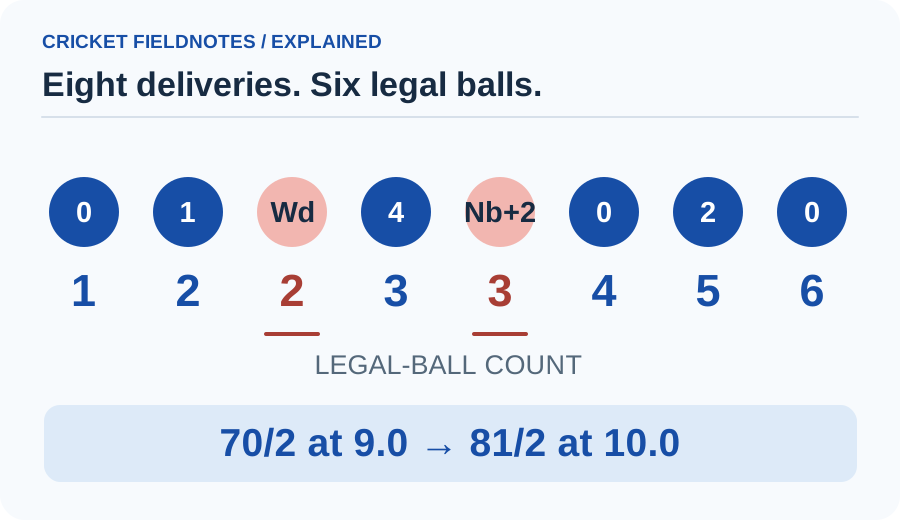
Hypothetical worked example. An innings begins this over at 70/2 after 9.0. In order, the bowler delivers: a dot, one run, a wide with no running, four off the bat, a no-ball struck for two, another dot, two runs, and a final dot. Assume no other infringement, short run, wicket or penalty.
| Event | Team addition | Valid balls this over |
|---|---|---|
| Dot, then single | 1 | 2 |
| Wide | 1 | 2 |
| Four | 4 | 3 |
| No-ball plus two off the bat | 3 | 3 |
| Dot, two, dot | 2 | 6 |
The total addition is eleven. The settled score is 81/2 after 10.0. Eight physical deliveries produced six valid balls. If your notebook showed 10.2, you counted the two extra deliveries in the innings clock. If it showed 80, check whether you missed one of the one-run penalties. This is why a separate arithmetic check is more useful than repeatedly watching the last delivery.
Worked example: a rate that changes with the denominator
Hypothetical worked example. A side has 96 runs after 14.2 overs. Convert first: fourteen times six plus two equals 86 balls. Its rate per six balls is 96 × 6 ÷ 86, approximately 6.70. Entering 96 ÷ 14.2 into a calculator instead gives about 6.76. Both answers look plausible, which makes this mistake easy to carry into a comparison.
Now imagine recording a second innings at 14.5. It has used 89 balls, only three more than the first snapshot. Write the ball count beside both totals before comparing the scoring pace. In a spreadsheet, store whole balls in one column and create the familiar over display separately. Arithmetic should operate on a uniform unit, while the presentation can remain recognisably cricket.
Worked example: how much of the chase remains?
Hypothetical worked example. In an uninterrupted twenty-over innings, the score reads 18.4. The side has used 112 of its scheduled 120 valid balls, leaving eight. A subsequent wide changes the target equation but still leaves eight valid balls. If the next two deliveries count, the display becomes 19.0 and six remain.
For a shortened innings, begin with the revised allocation rather than the original twenty overs. Also write down the current target shown by the officials. A ball counter cannot calculate a rain-adjusted target, and an old screenshot cannot tell you whether that target has since changed. Treat the allotted length and the target as inputs to your calculation.
Boundaries, mistakes and a viewing exercise
An over ends after the required valid balls and the ball becoming dead. The sixth delivery leaving the hand is not your cue to stop watching a possible run-out. Nor should you assume every dead-ball incident must be replaced: the reason and timing matter under Law 20. MCC also provides that an umpire's miscounted over stands; your personal tally is an aid to understanding, not authority to rewrite the official record.
Try this while watching: choose one over with an extra. Note its starting score, mark the valid deliveries, then reconcile the final score. In a second pass, describe the over without numbers: did the bowler recover after the extra, or continue missing the intended line? The first pass checks the record; the second turns a correct record into useful observation.
Sources & scope
Worked examples and diagrams are illustrative, not live match records. Scene photographs are AI-generated illustrations. Rules are reviewed against the linked sources; the applicable competition’s playing conditions take priority.