 Get RS9 APK
The full fieldnote.
Open a chapter for the working, examples and exceptions.
The quick answer
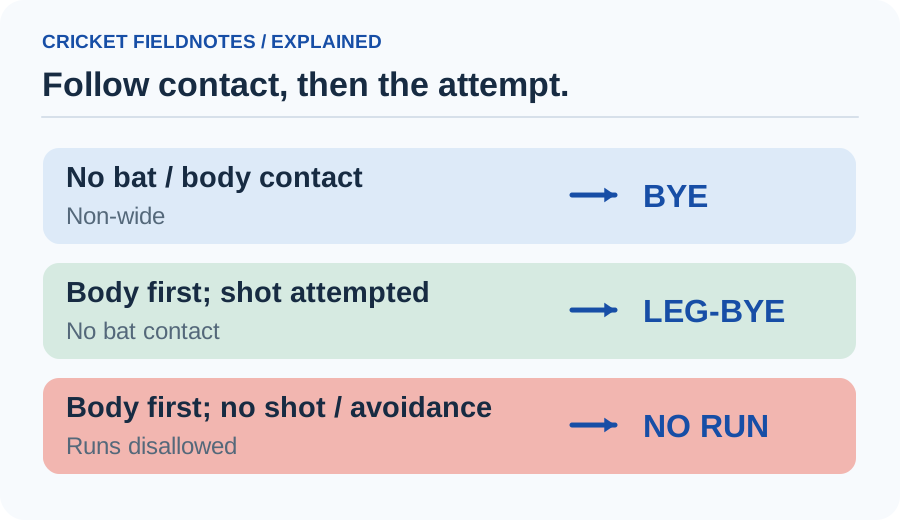
Byes arise when a non-wide passes the striker without touching bat or person and produces runs. Leg-byes concern body-first contact, with runs permitted only when the striker attempted to play the ball or avoid being hit. A no-ball penalty can accompany either category.
One less obvious detail matters: qualifying body-first contact followed by inadvertent bat contact can credit subsequent runs to the batter. If the leg-bye attempt requirement is not met, running does not manufacture a scoring entitlement. MCC Law 23 prescribes disallowing those runs and returning the surviving batters to their original ends, while applicable penalties are treated separately.
Build a contact map, not a guess
Use arrows in a notebook: ball → pad → keeper, or ball → empty space → outfield. This directs your attention to a sequence. A close-up of the ball beside a pad is not necessarily proof that it hit the pad; a noise can also need context. Let the umpire's signal and the final scorecard resolve a view that the camera cannot.
There are two different skills here. Scoring asks which category the rules assign. Evaluation asks whether a player could reasonably have prevented the runs. Keep a short opinion column beside the factual one. That allows you to say “recorded as byes; the ball appeared to deviate late” without converting an impression into an official finding.
Worked example: an unchanged batter score
Hypothetical worked example. The team is 61/2 and the striker has 28. A fair delivery passes between bat and body without touching either. The wicketkeeper cannot gather it cleanly, and the batters complete one run. Assume the umpire does not call wide and no other incident occurs. The total moves to 62/2; the striker stays on 28; one bye is recorded.
Suppose you saw only the batter walking to the other end and the team total increase. You would know that something changed, but not whether the striker scored. That is exactly the information an abbreviated highlight can omit. Check the scoring signal or full event description rather than inferring a batting single from movement between the wickets.
For a second viewing, watch the keeper's starting position and the ball's route. Write one neutral observation before offering a judgment. “The keeper changed direction after the bounce” is more useful for later discussion than “bad keeping”, because another viewer can compare the observation with the footage.
Worked example: change just one contact
Hypothetical worked example. A striker attempts a sweep. The ball hits the pad first, travels into the gap behind square, and the pair complete two. There is no bat contact, no no-ball, and the leg-bye requirement is satisfied. Record two leg-byes. The team gains two; the batter's runs do not increase.
Now alter only the contact sequence. After striking the pad, the ball inadvertently touches the striker's bat before continuing into the same gap. Keep the genuine attempted stroke and the two completed runs. In this variation, the two runs are credited to the batter. The gap, distance travelled and running are identical; the contact sequence supplies the difference.
Try describing both variations without the words “lucky” or “deserved”. That exercise helps separate the record from aesthetic opinion. An attractive stroke is not required for batting runs, and a clumsy-looking deflection does not automatically identify an extra.
Worked example: reaching the other end is not enough
Hypothetical worked example. A striker deliberately presents the pad, with no attempt to hit the ball and no attempt to avoid it. The ball hits the pad and rolls away. The pair complete a first run. Assume the umpire judges that neither qualifying attempt occurred and there is no other infringement.
The attempted run is disallowed under the leg-bye procedure. The surviving batters return to their original ends. In your notes, preserve both the physical event and the outcome: “pair ran once; no leg-bye awarded”. Deleting the physical event entirely makes the footage hard to reconcile, while treating it as a run makes the score wrong.
If a separate no-ball penalty applied, that penalty would still need recording. Keep it on its own line. This habit is especially useful when several signals follow one another and the television graphic initially shows a provisional total.
What to practise during the next match
Choose a five-over passage and note every occasion on which the batter's score and team score change by different amounts. For each, identify the category before evaluating the play. If you cannot see first contact, write “contact unclear” and wait for the official allocation.
At the end, add the recorded batting runs and extras for your passage. Reconcile them with the change in the team total. Do this once with sound and once without it: the difference will show which judgments came from visible evidence and which depended on the broadcaster's explanation.
Scope: ordinary deliveries without runners or unusual penalty incidents; checked against the MCC pages on 5 September 2026. For a specific competition, consult its applicable playing conditions. Do not use a future edition's effective date as evidence that an earlier match was decided incorrectly.
Sources & scope
Worked examples and diagrams are illustrative, not live match records. Scene photographs are AI-generated illustrations. Rules are reviewed against the linked sources; the applicable competition’s playing conditions take priority.