 Get RS9 APK
The full fieldnote.
Open a chapter for the working, examples and exceptions.
The quick answer
A run-out generally concerns a batter out of ground when a fielder fairly breaks that batter's wicket while the ball is live. A run need not be attempted. Stumping has narrower conditions: the striker is out of ground, has not attempted a run, and the keeper breaks the wicket without another fielder's intervention, on a delivery that is not a no-ball.
These are descriptions of conditions, not judgments about how far a batter moved. A short shuffle can matter as much as a long dash. Conversely, a dramatic dive can be safe if the required ground was already made.
Choose the right replay frame
Ordinarily, some part of the batter's body or bat must be grounded behind the popping crease. Law 30 also protects a batter who has made ground while running or diving towards and beyond it, then loses contact. That protection should not be extended to every later voluntary lift of a bat or foot.
Next inspect the wicket. Merely seeing a stump shake is insufficient. Law 29 sets the ways a wicket is fairly broken; in the usual case a bail must be completely removed, or a stump removed from the ground. For a fielder's hand or arm breaking it, the ball must be held in that hand or the hand of that arm.
On a replay, locate that event before comparing the bat with the crease. A screenshot taken a fraction too early can give a persuasive answer to the wrong question.
Worked example: the second run does not finish
Hypothetical worked example. The striker hits into the outfield. Both batters safely complete one run, turn, and attempt a second. The return reaches the keeper, who fairly breaks the striker's-end wicket while the batter running to that end is still short. Assume a fair delivery, a valid appeal, and no special exception.
The completed first run counts; the unfinished second does not. The batter whose ground is at the broken wicket is run out. The dismissal does not become a stumping merely because the keeper handled the return. Running was being attempted, and another fielder supplied the throw.
A useful viewing note separates the decisions: “second run attempted”, “throw collected”, “bail removed”, “bat short”. Only after those observations should you discuss whether the second run was sensible. A difficult throw arriving accurately can make a reasonable attempt fail; the result alone does not establish poor judgment.
Worked example: change wide to no-ball
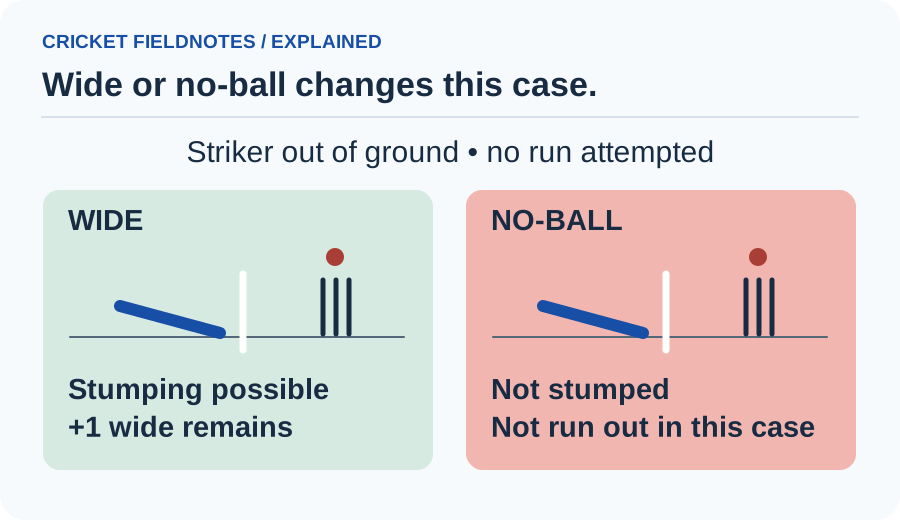
Hypothetical worked example. A striker advances to a spinner, misses, and remains outside the crease. No run is attempted. The keeper alone gathers the ball and fairly removes the bails. The delivery is wide, and the one-run penalty does not end the match. Subject to the other stumping conditions, the striker can be stumped and the wide penalty remains.
Now change the delivery to a no-ball while keeping everything else identical. The striker cannot be stumped. Nor may this exact keeper-only, no-run-attempt situation simply be relabelled run-out: Law 38 contains a specific exception. That is why “you can be run out on a no-ball” is an incomplete answer to this replay.
Change the facts again by having the batter attempt a run or another fielder intervene, and you must reassess the run-out conditions. Do not carry the result of one version into another after changing a decisive fact.
Worked example: a bouncing bat
Hypothetical worked example. A runner dives towards the crease, grounds a held bat beyond it, and continues forward. The bat momentarily bounces off the turf during that same movement just before the wicket is broken. Under the running-and-diving protection in Law 30, the later loss of contact does not by itself make that batter out of ground.
Compare a striker who is stationary after a delivery and lifts the back foot while the bat is also raised. That is a different fact pattern. A freeze-frame with everything airborne cannot tell you which scenario occurred; the preceding frames matter. Ask the broadcast to establish the sequence before drawing a conclusion from the still image.
A four-line replay worksheet
For the next close chance, write four lines: delivery status; who touched the ball; whether a run was attempted; the ground-and-wicket timing. If one line remains unknown, make the uncertainty explicit. This produces a much clearer conversation than choosing “out” first and searching for a supporting frame.
A non-striker leaving early is another run-out situation with its own time window in Law 38.3. The bowler's normal release point, defined through the arm reaching its highest point in the normal delivery swing, limits that procedure. Do not infer a timeless right to dismiss the non-striker whenever the bowler happens to retain the ball.
Scope: checked 5 September 2026; examples exclude runners and assume valid appeals. Injury-avoidance exceptions and event replay protocols require their own facts. Consult the named competition's conditions for a real incident.
Sources & scope
Worked examples and diagrams are illustrative, not live match records. Scene photographs are AI-generated illustrations. Rules are reviewed against the linked sources; the applicable competition’s playing conditions take priority.