 Get RS9 APK
The full fieldnote.
Open a chapter for the working, examples and exceptions.
The quick answer
A wide and a no-ball normally bring a one-run penalty and do not count in the over. A no-ball overrides a wide. Neither call automatically ends play. To understand the final score, identify what happened after the delivery as well as why the umpire called it.
The MCC baseline judges a wide through the striker's reach for a normal stroke and relevant batting positions; contact with bat or body changes that assessment. No-balls cover specified infringements, not just an overstepping bowler. Format and event regulations can modify the details, so a painted guide line or a television commentator's shorthand is not a complete rulebook.
Ask three separate questions
First, what was the delivery's status? Second, where did the runs come from? Third, what does the next delivery require? Keep those questions in that order. A fan who jumps straight from the no-ball signal to an expected free hit can miss a boundary, an attempted extra run, or the scorer's allocation.
In your notes, a useful line has four fields: call, contact, completed running, total change. You need no elaborate notation. A sentence such as “no-ball; bat; two completed; three added” is easier to audit later than an isolated “3”. It also preserves the difference between the batter's contribution and the team's increase.
Worked example: three runs with no bat involved
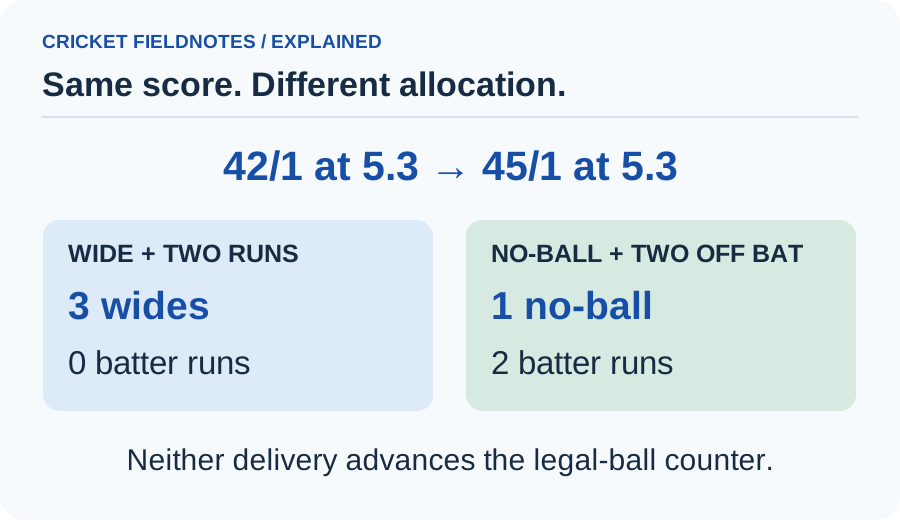
Hypothetical worked example. The board reads 42/1 at 5.3. A delivery is called wide, passes untouched by the striker, and escapes the wicketkeeper. The batters safely complete two runs before the return arrives. There are no other penalties. Three runs are added, all as wides, taking the score to 45/1 while the valid-ball display stays at 5.3.
Imagine two friends recording this play. One writes “two byes” because the keeper did not gather it. The other writes “three wides” after following the signal. Their total may be close, but their descriptions tell different stories. The wide classification governs this delivery's allocation; the keeper's involvement does not turn it into byes.
For analysis, add a separate observation: was the ball far from the keeper, did it change direction, or was a routine collection missed? Those are viewing judgments. The extras column itself does not answer them, and it should not be used alone to assign blame.
Worked example: the same team addition, a different split
Hypothetical worked example. Start again at 42/1 after 5.3. This time the bowler delivers a front-foot no-ball and the striker drives it, completing two runs. The score again becomes 45/1 at 5.3, but the batter receives two and the extras record receives one no-ball. The identical headline score hides a different event.
For the front-foot check, the relevant landing must leave some part of that foot behind the popping crease; that part may be raised. Looking only at where the foot ends its slide can mislead a viewer. Use a replay that shows the landing, and let the official adjudication settle the record.
Now write the next-delivery note separately. In the ICC Men's T20I conditions effective July 2025, a no-ball is followed by a free hit. A wide or another no-ball on that free hit carries the free hit forward. Those provisions come from the playing conditions, so do not automatically transfer them to a match played under a different framework.
Three shortcuts that lose information
- “Every extra goes against the bowler.” MCC's scoring law distinguishes bowler debits from the team's total. Byes and leg-byes are separate; a bowling analysis need not add up to the entire innings score.
- “A free hit means nothing can happen to the striker.” The ICC provision preserves the dismissal circumstances applicable to a no-ball, including run-out. Continue following the running and the ball.
- “That was a wide in another tournament.” Check the named event's document, edition and addenda before treating a comparison clip as a precedent.
The useful question is specific: which part of this delivery is disputed? Foot placement, the striker's position, contact and scoring allocation require different evidence. Replaying the entire ball at full speed five times may reveal less than locating the one relevant moment.
A short exercise in reconciling extras
During your next innings, collect three extra-producing deliveries. For each, record the starting total, the settled ending total and the extras label. Then compare the batter's score before and after. Can you reconstruct each change without relying on the commentary?
Finally, cover your original notes and explain each play in one sentence to a new viewer. Include the difference between the team addition and the batter's addition. If that sentence needs a guess about contact or a missing umpire signal, label the gap instead of filling it from memory. Accurate observation begins with recognising what the broadcast actually showed.
Edition note: checked 5 September 2026. MCC's next edition starts on 1 October; the relevant tournament's conditions remain the place to verify free hits, wide interpretation and local variations.
Sources & scope
Worked examples and diagrams are illustrative, not live match records. Scene photographs are AI-generated illustrations. Rules are reviewed against the linked sources; the applicable competition’s playing conditions take priority.