 Get RS9 APK
The full fieldnote.
Open a chapter for the working, examples and exceptions.
Two rates, two time windows
Current run rate is team runs per over already faced. Required run rate is the remaining runs needed to win per over still available. They can move in opposite directions. A team's current rate can rise while its required rate also rises if it scores faster than its past pace but slower than the remaining chase demands.
The worked chase below is invented. It assumes an uninterrupted twenty-over innings, six valid balls per over, and an unchanged target. It is a calculation exercise, not a match prediction. Wickets, bowling quality and the difficulty of scoring are outside these two formulas.
Decode 14.3 without using decimal overs
At 14.3 overs, fourteen complete overs and three valid balls have been used. That is 14 × 6 + 3 = 87 balls. A twenty-over allocation contains 120, leaving thirty-three. Expressing thirty-three balls as 5.3 overs is fine for display; using the decimal 5.3 in a division is not.
| Display | Calculation | Balls |
|---|---|---|
| 14.3 elapsed | 14 × 6 + 3 | 87 |
| 20.0 allocation | 20 × 6 | 120 |
| 5.3 remaining | 120 − 87 | 33 |
A suffix of six should carry into the next over. For example, fifteen overs follows 14.5 plus one valid ball; a normal live display does not remain at 14.6.
Work the chase from a target, not the first total
Suppose the target is 181 and the chasing team has 122 at 14.3. It needs fifty-nine more runs to win. Using 180 instead would count only the runs required to draw level, leaving the winning run out of the question.
| Measure | Calculation | Result |
|---|---|---|
| Current rate | 122 × 6 ÷ 87 | 8.41 |
| Runs needed | 181 − 122 | 59 |
| Required rate | 59 × 6 ÷ 33 | 10.73 |
The two rates answer different questions. Replacing required rate with current rate would assume the past scoring pace is sufficient without checking the target.
Watch both rates rise
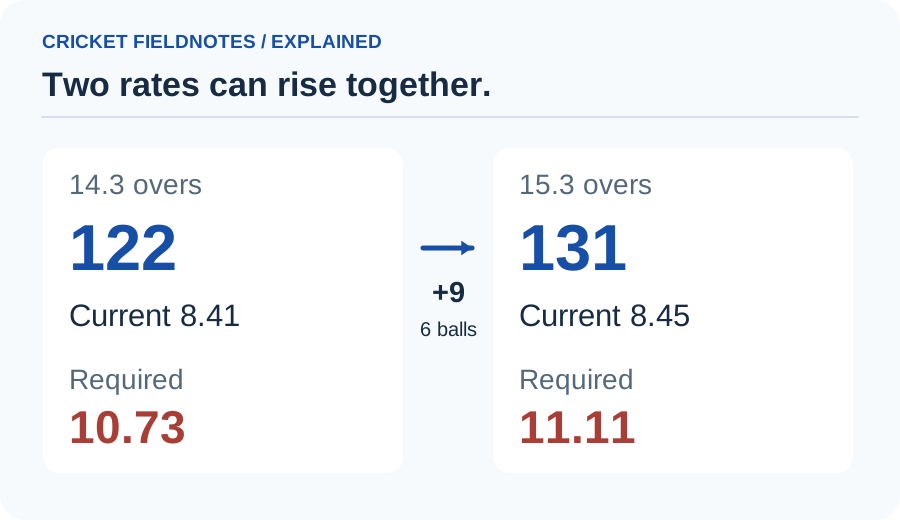
Now the team scores nine from its next six valid balls. It reaches 131 at 15.3, leaving fifty to win from twenty-seven. Current rate becomes 131 × 6 ÷ 93 = 8.45. Required rate becomes 50 × 6 ÷ 27 = 11.11.
Current pace improved from 8.41 to 8.45, but the remaining requirement increased from 10.73 to 11.11. Nine runs exceeded the team's earlier average while falling below the chase's required pace. This example explains why an encouraging-looking over can still leave the numerical task harder. The relevant comparison is the rate needed before those six balls, not only the rate already achieved.
Use a benchmark without pretending it is a forecast
At the original fifty-nine-from-thirty-three position, eighteen runs from the next twelve valid balls would leave forty-one from twenty-one. The new required rate would be 11.71. Twenty-four from those twelve would leave thirty-five from twenty-one, reducing it to 10.00.
These are scenarios chosen to expose cause and effect. They are not expected outcomes and should not be labelled a winning probability. A required rate of ten does not imply that scoring ten every over is the only path; boundaries and singles arrive unevenly, and the final segment may contain fewer than six balls.
Handle finished and interrupted innings explicitly
With no valid balls faced, current run rate has no denominator. With zero balls remaining and runs still needed, display the innings outcome rather than an infinite required rate. Once the target is reached, show that the chase is complete instead of continuing a negative runs-needed calculation.
For a rain-affected match, use the official revised target and allocation. Do not multiply an old target by a simple overs ratio and call it DLS. A target may have changed since a screenshot was taken; confirm the scorecard timestamp before comparing two displays. Wides and no-balls can also alter runs without consuming a valid ball.
Try the smaller chase
A fictional team has 73 after 9.4 overs in a fifteen-over innings, chasing 121. Find balls faced, balls remaining and required rate.
Show the answer
It has faced fifty-eight valid balls out of ninety, leaving thirty-two. Forty-eight runs remain, so required rate is 48 × 6 ÷ 32 = 9.00. Current rate is 73 × 6 ÷ 58 = 7.55.
The arithmetic is complete; the competitive assessment is not. Add wickets, available batters and actual conditions before writing that the chase is comfortable or difficult.
Sources & scope
Worked examples and diagrams are illustrative, not live match records. Scene photographs are AI-generated illustrations. Rules are reviewed against the linked sources; the applicable competition’s playing conditions take priority.