 Get RS9 APK
The full fieldnote.
Open a chapter for the working, examples and exceptions.
NRR compares two aggregate rates
Net run rate subtracts a team's overall rate of conceding runs from its overall rate of scoring runs across the relevant competition stage. It is not the simple average of individual match NRRs. Start with the underlying runs and eligible overs, make any required adjustments, then divide.
Our scope follows the calculation described in clause 16.10.7 of the ICC Men's T20 World Cup 2026 playing conditions. Other competitions must be checked against their own regulations. Every team and score below is invented to demonstrate the method. Nothing here is a current points table or qualification forecast.
Build four totals from two invented wins
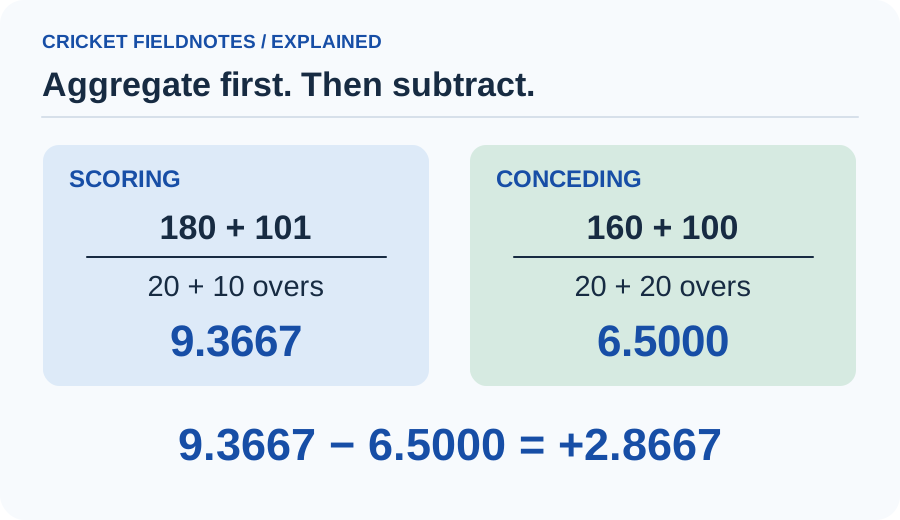
In Match A, Harbour scores 180 in twenty overs and holds its opponent to 160 in twenty. In Match B, the opponent scores 100 in twenty and Harbour chases it with 101 in ten. Both games are uninterrupted, and neither needs an all-out adjustment.
| Match | Runs for | Overs faced | Runs against | Overs bowled |
|---|---|---|---|---|
| A | 180 | 20 | 160 | 20 |
| B | 101 | 10 | 100 | 20 |
| Aggregate | 281 | 30 | 260 | 40 |
Harbour scores at 281 ÷ 30 = 9.3667 runs per over and concedes at 260 ÷ 40 = 6.5000. Its NRR is therefore +2.8667, normally displayed with fewer decimal places.
Why averaging the two match numbers fails
Match A alone gives 9.00 − 8.00 = +1.00. Match B alone gives 10.10 − 5.00 = +5.10. Their simple average is +3.05, which does not match +2.8667. The discrepancy comes from giving two differently sized batting exposures equal weight.
In Match B, Harbour used only ten overs while conceding runs over twenty. One combined weight cannot repair both sides by casually averaging the two match NRR values. Maintain separate scoring and conceding totals. For partial overs, store valid balls and calculate six times runs divided by balls; round only the final display.
Apply the all-out quota to the denominator
The cited ICC conditions count an all-out innings using the full overs allocation available to that side. Consider an invented team dismissed for 100 in twelve overs of a twenty-over innings. Its contribution to the scoring-rate denominator is twenty overs, giving 5.00, rather than twelve overs and 8.33.
For another invented match already reduced to twelve overs, a team all out for 84 in ten contributes twelve overs: 7.00. Do not automatically substitute twenty. Record the allocation applicable to that innings, not the format's usual maximum. These examples are accounting illustrations; they do not calculate rain revisions.
A win can lower an existing NRR
Return to Harbour's +2.8667 record. In a third invented match, it scores 200 in twenty overs and wins by holding the opponent to 190 in twenty. Its new aggregate is 481 from fifty overs, against 450 from sixty. That gives 9.62 − 7.50 = +2.12.
Harbour won, yet its NRR fell. The latest game's scoring and conceding rates changed the running aggregates less favourably than the existing record. This is not a scoring error and does not take the win away. Points and NRR are different table fields; read the competition's ordering criteria before treating either as the whole standings story.
Stop when the simple inputs no longer apply
The cited event conditions exclude Super Over figures from NRR and use only matches with results. They also prescribe adjusted accounting for matches decided with DLS. A basic runs-and-overs calculation using unadjusted scorecard totals can therefore disagree with the official table even when every division is correct.
For a disputed figure, build a match ledger showing stage, result status, allocation, all-out flag, counted runs and counted balls. Compare one row at a time with the relevant regulations. Do not combine groups or carry earlier-stage matches forward unless that competition says to do so. Missing adjustments should be labelled unresolved rather than concealed behind rounded output.
Reconstruct one complete record
In one invented uninterrupted match, your team scores 150 from twenty overs. Its opponent is all out for 120 after sixteen overs of the same twenty-over allocation. What is your team's NRR contribution if this is its only counted game?
Show the answer
Your scoring rate is 7.50. The opponent's all-out innings uses twenty overs, so your conceding rate is 6.00. NRR is +1.50. Using sixteen overs would incorrectly produce zero.
For an actual qualification scenario, verify the official table first and preserve full-precision inputs. Display rounding is not a substitute for the competition's tiebreak rules.
Sources & scope
Worked examples and diagrams are illustrative, not live match records. Scene photographs are AI-generated illustrations. Rules are reviewed against the linked sources; the applicable competition’s playing conditions take priority.