 Get RS9 APK
The full fieldnote.
Open a chapter for the working, examples and exceptions.
The partnership belongs to the team account
A partnership describes runs added while a particular pair bats together. It includes extras added during that stand, so it need not equal the two batters' personal contributions. Strike rotation describes which partner faces the next delivery. These ideas connect, but they are not interchangeable.
Every number and sequence on this page is invented for learning. We use an ordinary six-ball over with no wickets, penalties, short runs or unusual dead-ball incidents in the rotation example. Those boundaries matter: simply applying odd-and-even arithmetic to a dismissal or an overthrow can give the wrong answer.
Reconcile the stand before praising the pair
Our imaginary team is 52/2 when Asha joins Ben. The next wicket falls at 101/3. They have added forty-nine team runs. During the stand Asha scores twenty, Ben scores twenty-five and extras contribute four. The partnership is forty-nine, not forty-five.
| Component | Runs | Share of stand |
|---|---|---|
| Asha | 20 | 40.82% |
| Ben | 25 | 51.02% |
| Extras | 4 | 8.16% |
| Total | 49 | 100% |
Use each batter's runs during the stand, not their full innings scores. Ben may have accumulated runs before Asha arrived. A partnership graphic and the main batting card can therefore display different numbers for him without either being wrong.
Track one over, delivery by delivery
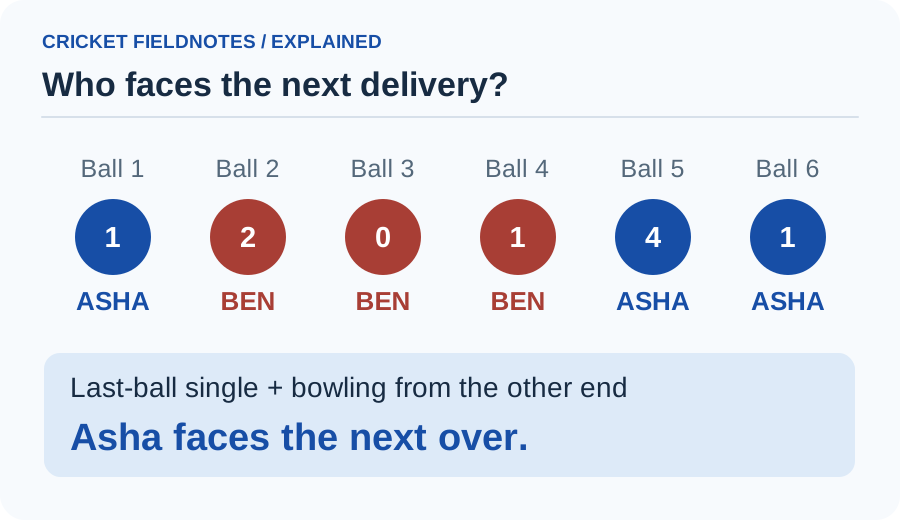
Start a fresh invented over with Asha facing. All runs below are completed running runs except the four, which is a normal boundary. Write the striker's name before writing the result; that makes it harder to credit runs to the wrong person.
| Ball | Striker | Runs | Next striker within the over |
|---|---|---|---|
| 1 | Asha | 1 | Ben |
| 2 | Ben | 2 | Ben |
| 3 | Ben | 0 | Ben |
| 4 | Ben | 1 | Asha |
| 5 | Asha | 4 | Asha |
| 6 | Asha | 1 | Over complete |
Asha scores six and Ben three. Each faces three balls. The pair adds nine without requiring both batters to use the same scoring pattern.
The last-ball single needs a second step
Who faces the next over? Asha does. Her last-ball single changes the batters' ends, then bowling begins from the opposite end. Those two changes mean the batter who took that final single faces again. After an ordinary dot or boundary from that last delivery, Ben would instead face the next over.
Do not decide this from whether the total team score increased by an odd number. A one-run wide penalty with no running adds one to the score without exchanging the batters' ends. Track the action that moved them, then apply the change of bowling end. The scoreboard total alone is insufficient.
Contribution is wider than the larger score
A partner who contributes fewer runs may still consume difficult deliveries, keep the other batter involved or remain present while the innings recovers. Those are possibilities to investigate, not facts proven by the partnership total. Balls faced, dots, boundary timing and the match situation help test the explanation.
Likewise, frequent strike changes do not automatically make a partnership effective. Six singles add six runs; three dots followed by three fours add twelve. Which sequence fits the moment depends on the target, wickets and scoring opportunities. Describe what happened before assigning intent such as protecting a partner or deliberately controlling a matchup.
Keep complicated endings out of shortcuts
A run-out, a catch, a short run or a retirement can interrupt the simple pair-and-score picture. In those cases, consult the official dismissal record and the applicable Laws rather than extending this clean six-ball example. MCC Law 18 addresses where batters return after specific events; the categories matter.
For analysis, record the stand's start and end score, contributions, extras and valid balls if available. If a public card omits partnership balls, label that field unknown. Subtracting two rounded over labels as decimals will not recover it. Convert each complete overs-and-balls position to an integer ball count first.
Try a final-ball decision
In a new invented over, Ben faces the sixth valid delivery. He completes two ordinary runs. Who faces the first delivery of the next over? Now change those two runs to one and answer again.
Show the answer
After two runs, the batters return to their previous ends, so Asha faces from the opposite end next over. After one run, they exchange ends, so Ben faces again when the bowling end changes.
State the assumptions when explaining your answer. No dismissal or special ruling occurs in this exercise.
Sources & scope
Worked examples and diagrams are illustrative, not live match records. Scene photographs are AI-generated illustrations. Rules are reviewed against the linked sources; the applicable competition’s playing conditions take priority.