 Get RS9 APK
The full fieldnote.
Open a chapter for the working, examples and exceptions.
Start with three questions
A scorecard is several connected accounts. Start by asking which innings you are seeing, how many runs the team has, and how many valid balls have been used. Then look at individual performances. A display of 146/6 after 18.2 overs describes a team score, wickets lost and innings progress. It does not tell you whether the team is ahead without the format, target and conditions.
The examples below are invented for teaching. They are not scores from a real fixture. Our imaginary side, Harbour, is batting first in an uninterrupted twenty-over game. No rain adjustment or unusual penalty applies.
Make the batting account add up
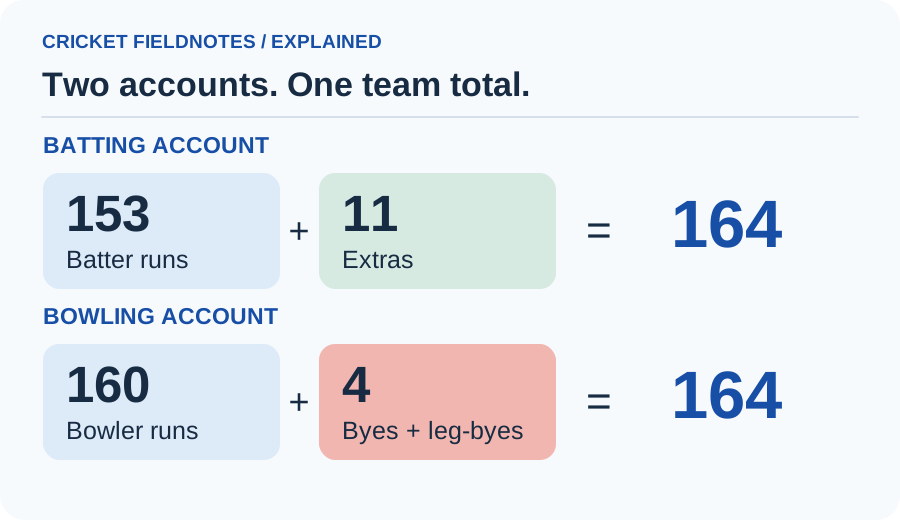
At the end, Harbour has 164/6. Its eight batters have recorded 36, 22, 41, 0, 18, 7, 20 not out and 9 not out. Those individual scores total 153, leaving eleven runs to explain. The extras line supplies the missing eleven. This is a useful arithmetic check before making any claim about a player or innings.
| Account | Calculation | Runs |
|---|---|---|
| Batter scores | 36 + 22 + 41 + 0 + 18 + 7 + 20 + 9 | 153 |
| Extras | 6 wides + 1 no-ball + 2 byes + 2 leg-byes | 11 |
| Team total | 153 + 11 | 164 |
MCC Law 18 distinguishes runs credited to the striker from extras. Keep that distinction when reading a partnership or calculating a batter's strike rate.
Treat the ball suffix as a count
The notation 18.2 means eighteen completed overs plus two valid balls: 18 × 6 + 2 = 110 balls. It is not 18.2 decimal overs. At that moment Harbour has ten valid balls remaining in its allocation of 120. Reaching 164 from 146 therefore adds eighteen runs from those ten balls.
An over can contain more than six deliveries because some deliveries do not count towards its six valid balls. A scorecard's overs column is therefore not a count of every occasion the bowler released the ball. MCC Law 17 supplies the underlying six-ball convention. Your arithmetic should convert notation to balls before division.
Read the dismissal, not just the wicket count
The zero in our batting list means that batter scored no runs; it says nothing by itself about how long the innings lasted. Check the balls column and dismissal text. Likewise, a not-out marker describes the batter's status when that innings ended. It is not an extra run and should never be added to the team total.
Now imagine five of Harbour's dismissals are credited to bowlers and one is a run-out. The bowling wickets column can total five while the team has lost six. That is consistent. A catch normally names the catcher and bowler; the fielding contribution is not a second team wicket.
Cross-check the bowling account
Suppose the five bowlers' conceded runs are 29, 32, 35, 30 and 34. They total 160, four fewer than Harbour's 164. Our two byes and two leg-byes account for that difference: the team received them, but they were not charged as runs against the bowlers. The wides and no-ball extra are already inside those bowling figures.
Do not automatically label every mismatch an error. First identify what the table includes. Then check the extras breakdown, any penalty annotations and whether the displayed innings is complete. A cropped screenshot can omit the very row that makes the accounts reconcile.
Recover the shape of the innings
The final total compresses twenty overs into one number. Fall-of-wickets entries restore some sequence: they show the team score when wickets fell. A progression of 40/1, 42/2 and 43/3 tells a different story from three wickets spread across the innings, even if the final score matches.
Use that sequence to form a question, not a verdict. A quick cluster may reflect difficult bowling, risky decisions or exceptional fielding; the summary cannot tell you which. Read the relevant ball commentary before describing a collapse as careless. Phase totals, partnerships and dismissal details enrich the account without pretending to reconstruct shots you did not see.
Try the two-account check
Practice with another invented innings: batter runs total 127; extras are seven wides, one no-ball, three byes and two leg-byes. What is the team total, and how many runs should the bowling figures contain if no other penalties apply?
Show the answer
The team total is 140. The bowling figures contain 135: 127 batter runs plus eight wides/no-ball extras. The remaining five runs are byes and leg-byes. Reconcile both totals before interpreting economy rates.
For a real match, the official scorecard and umpires' decisions take precedence over this simplified learning example.
Sources & scope
Worked examples and diagrams are illustrative, not live match records. Scene photographs are AI-generated illustrations. Rules are reviewed against the linked sources; the applicable competition’s playing conditions take priority.