 Get RS9 APK
The full fieldnote.
Open a chapter for the working, examples and exceptions.
The quick answer
A fair catch requires a qualifying ball off the bat, held before grounding, with the relevant boundary conditions satisfied. A no-ball cannot produce a caught dismissal. The catching action ends when the fielder controls both the ball and their own movement; the first instant the hands close is not necessarily the end.
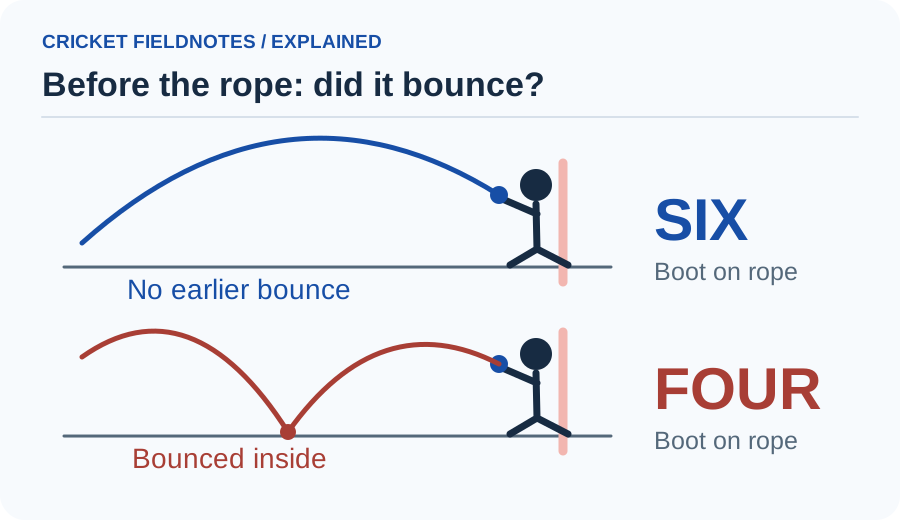
For an ordinary boundary, check where the ball grounds and whether a fielder touching it is grounded on or beyond the boundary. A bat-struck ball first grounded beyond the boundary without an earlier ground contact inside normally scores six; otherwise an ordinary boundary generally scores four. An airborne journey over the rope alone does not tell the full story.
Watch the catch in three passes
On the first pass, follow the ball from the bat to the hands and beyond. On the second, follow the fielder's feet and body. On the third, examine the point at which the movement becomes controlled. Separating those tasks is easier than trying to judge the ball, shoes, rope and landing simultaneously.
Write down the uncertainty precisely. “I cannot see whether the ball touched the turf under the fingers” is a useful statement. “That looked wrong” gives nobody a fact to test. Camera angles may complement each other, but a change of angle can also hide the continuity you are trying to establish. Keep the time sequence intact.
Worked example: a bobble away from the boundary
Hypothetical worked example. A fair delivery is edged towards slip. The fielder touches the ball with both hands, loses it briefly above the shoulder, and gathers it again without the ball touching the ground. The fielder then stands balanced with the ball securely held. Assume no other infringement. The bobble does not itself defeat the catch; the completed sequence supplies the answer.
Now imagine the ball touches the turf before the second gathering. The final pose might look identical, but the intervening contact changes the assessment. A highlight beginning with the second gathering would remove the decisive information. This is why a celebratory freeze-frame is a poor substitute for the whole catching action.
The batters' running while an ordinary catch is being completed does not create runs that survive a caught dismissal. Keep that separate from a dropped chance, where subsequent live-ball events still require attention.
Worked example: the boot supplies the missing detail
Hypothetical worked example. A lofted shot has not bounced. A deep fielder receives it just inside the rope but, before completing control of the catch, steps on the boundary cushion while still holding the ball. With ordinary boundary allowances and no other complication, the result is six, not a catch.
Change the shot so it had already bounced inside the field before reaching the same fielder. The corresponding ordinary boundary is four. The fielder's position alone does not distinguish four from six; you need the ball's earlier ground contact too.
A second boundary detail can matter after a dive: if the marker has been displaced, MCC treats the boundary as remaining in its original position. Look for the original line or reliable replay evidence. A moved cushion is not permission to redraw the field midway through the delivery.
Worked example: a relay under ICC conditions
Hypothetical worked example under the ICC boundary change introduced in 2025. Fielder A first contacts the ball after taking off from inside, pushes it upward, then goes beyond the rope. A jumps from outside, makes one further airborne contact to send it towards teammate B, and lands wholly inside. A remains inside while B completes the catch. Assuming every other requirement is satisfied, this is the sort of sequence the revised condition permits.
Alter A's landing so A comes down outside after that further airborne touch. B's eventual clean gathering does not repair that failure. Keep watching A after the relay; following only B would miss a condition that still governs the outcome.
ICC announced this requirement in June 2025, ahead of its inclusion in MCC's next Laws edition. MCC's fourth edition begins on 1 October 2026. For a particular domestic event or an older clip, identify the document in force before applying this example.
A replay checklist you can actually use
For your next boundary chance, record: delivery status; bat contact; any ground contact by the ball; the fielder's contact with the boundary; completion of control. Add a separate line for the landing and subsequent position in an airborne relay governed by the ICC condition. A blank line is an honest record of unavailable evidence.
Do not turn every ball near the rope into a catch-or-six binary. A failed catch may remain inside, a previously bouncing ball may produce four, and an overstepping delivery changes the dismissal question. Start with the actual route of the ball and work forward.
For a useful exercise, explain one replay aloud in chronological order without saying “out” or “six” until the final sentence. If your explanation skips the landing or the moment of control, replay that portion. The aim is a reasoned account another viewer can inspect, not the fastest verdict.
Scope: checked 5 September 2026. Examples assume ordinary boundaries, no overthrows or unusual ground agreements, and the specified competition framework.
Sources & scope
Worked examples and diagrams are illustrative, not live match records. Scene photographs are AI-generated illustrations. Rules are reviewed against the linked sources; the applicable competition’s playing conditions take priority.