 Get RS9 APK
The full fieldnote.
Open a chapter for the working, examples and exceptions.
Speed and runs per dismissal
Batting strike rate measures runs per hundred balls faced. Batting average divides accumulated runs by dismissals. Neither number contains a complete judgement of a batter. A fast innings and a long innings can be valuable in different circumstances, and a small sample can make either statistic look unusually impressive.
This guide uses invented players and results throughout. The examples demonstrate arithmetic and interpretation; they are not current player rankings. The ICC uses runs per hundred balls when discussing strike rate, and its explanation of rankings identifies dismissals as the denominator in the batting-average comparison.
Calculate a single innings carefully
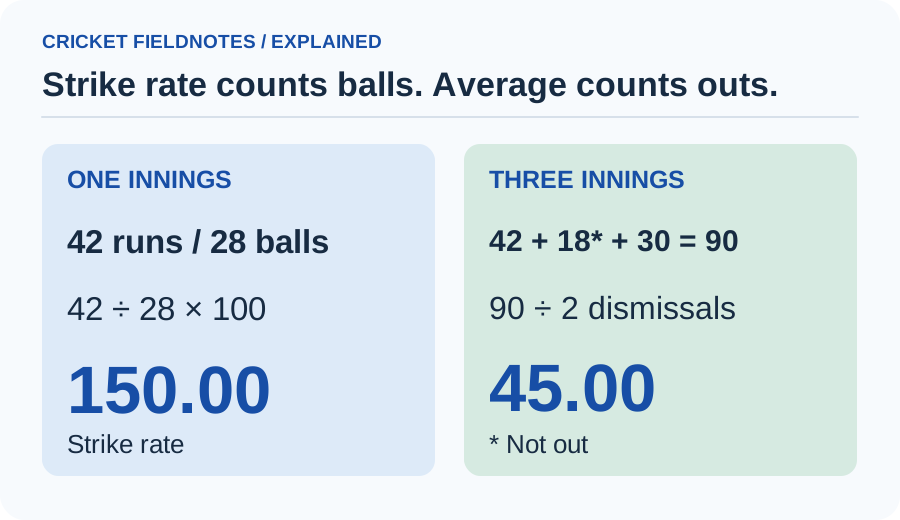
Our imaginary batter Mira scores 42 from 28 balls. Divide 42 by 28 to get 1.5 runs per ball, then multiply by 100: a strike rate of 150.00. That does not mean she scored 150 runs, faced one hundred balls, or will maintain the same pace if she continues.
| Batter | Runs | Balls | Calculation | Strike rate |
|---|---|---|---|---|
| Mira | 42 | 28 | 42 ÷ 28 × 100 | 150.00 |
| Dev | 15 | 10 | 15 ÷ 10 × 100 | 150.00 |
| Leela | 30 | 25 | 30 ÷ 25 × 100 | 120.00 |
Mira and Dev have the same rate, but Mira produced more runs over a longer observed innings. Keep the raw counts visible.
Build the average from the innings record
Across three imaginary innings, Mira scores 42 dismissed, 18 not out and 30 dismissed. She has ninety runs and two dismissals, so her batting average is 45.00. Dividing by three gives thirty runs per innings, which is a different statistic. The unbeaten eighteen remains in the numerator even though that innings adds no dismissal.
Now compare Dev's 30 dismissed, 30 dismissed and 30 dismissed. He also has ninety runs, but three dismissals produce an average of 30.00. The difference follows from the records; it does not prove Mira would have reached a particular score had her unbeaten innings continued.
Add runs and balls before taking the rate
Suppose Mira's three innings were 42 from 28, 18 from 12 and 30 from 40. Her total is ninety from eighty balls, giving an overall strike rate of 112.50. Averaging the three innings rates of 150, 150 and 75 instead gives 125, which is wrong for the combined record.
The last innings occupied half of her eighty balls. An ordinary average of the three displayed percentages gives that long innings only one third of the weight. Returning to total runs and total balls preserves the actual exposure. The same principle matters when combining a tournament, a season or several selected match phases.
Know when the calculation has no answer
A record with zero balls faced has no defined batting strike rate. A record with no dismissals has no finite batting average under the usual formula. Use a dash or a clear not-applicable label; displaying zero invents a poor performance, while displaying a huge number invents precision.
Do not silently replace missing historical balls-faced data with zero. A known run total without a reliable ball count cannot support a strike rate. Similarly, check whether a provider's filtered table includes every innings and retains not-out status. A calculator can perform exact division on incomplete inputs and still answer the wrong question.
Compare like opportunities
A batter entering with five balls left has different opportunities from an opener facing the first delivery. Match format, phase, opposition and conditions are useful context. Start comparisons inside a sensible group and show innings, dismissals and balls alongside the headline rates.
Consider an invented start of six runs from two balls: strike rate 300. After four dots, the same batter is six from six, strike rate 100. Nothing about the first calculation was arithmetically false. Its weakness was the tiny amount of evidence. Avoid converting a two-ball observation into a confident statement about long-term ability.
Your turn: one record, two answers
An invented batter records 25 from 20 dismissed, 15 from 10 not out and 40 from 30 dismissed. Calculate the overall strike rate and average before opening the answer. Then describe one limitation that remains even after the sums are correct.
Show the answer
Eighty runs from sixty balls gives a strike rate of 133.33. Eighty runs from two dismissals gives an average of 40.00. Only three innings are represented, and the numbers alone do not reveal entry point, conditions or opposition strength.
That final sentence is part of reading the statistic well. A precise number should make the evidence easier to inspect, not remove the need to inspect it.
Sources & scope
Worked examples and diagrams are illustrative, not live match records. Scene photographs are AI-generated illustrations. Rules are reviewed against the linked sources; the applicable competition’s playing conditions take priority.