 Get RS9 APK
The full fieldnote.
Open a chapter for the working, examples and exceptions.
The dimensions you are looking for
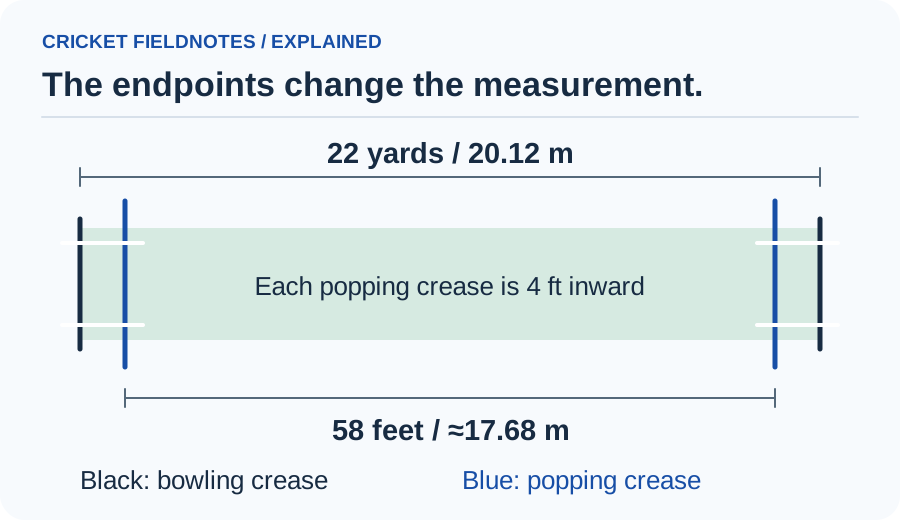
MCC Law 6 defines the standard pitch as 22 yards, or 20.12 metres, long and 10 feet, or 3.05 metres, wide. Its ends are the bowling creases. The popping crease at each end is four feet in front of the bowling crease. That makes the straight separation between the two popping creases 58 feet, approximately 17.68 metres.
The pitch is the central playing strip, not the entire field inside the boundary. Junior pitch length is determined by the relevant governing body, so do not use an adult measurement to judge whether a children's match has been set up incorrectly.
Name the lines before judging the replay
| Marking | Where to look | Measurement reference |
|---|---|---|
| Bowling crease | The transverse line at the wicket | Back edge; 8 feet 8 inches long |
| Popping crease | The parallel line in front | Back edge; four feet from bowling crease |
| Return creases | The lines running back on either side | Inside edges; each four feet four inches from the centre line |
The popping and return creases have specified minimum painted lengths but are treated as unlimited lines. A batter running wide of the visible white paint has not found a place where the crease ceases to exist. For a close decision, first identify the relevant line and edge; the thickness of the paint should not become an improvised rule.
Worked example: a paper pitch that keeps its proportions
Hypothetical worked example. Draw a 22-centimetre line on paper and let one centimetre represent one yard. Mark the wickets at its ends. Four feet is one and one-third yards, so place each popping crease about 1.33 centimetres inward from its wicket. The gap between those two marks is about 19.33 centimetres on your drawing.
Now label the whole drawing “22 yards” and the inner gap “58 feet”. The labels are compatible because they describe different endpoints. If you initially thought they conflicted, you were probably measuring from the wickets in one case and from the popping creases in the other.
A batter's actual movement is another quantity again. Starting position, a turn, the reach of the bat and a run taken at an angle all change the route. The sketch helps orient a replay; it is not a fitness test prescribing how far every individual must travel.
Worked example: a line that seems to disappear
Hypothetical worked example. A throw pulls a runner several steps to the side of the wicket. The camera shows the bat reaching beyond the end of the painted popping-crease mark. A viewer asks whether the bat must return to the paint itself to make ground.
Extend the popping-crease line in your drawing. Its legal extent continues beyond the visible marking. The separate ground question is whether the batter satisfies Law 30 relative to that extended crease. This example assumes ordinary ground conditions; it does not decide the exact timing of an unseen bat touching down.
Watch a replay once for the geometry and again for the timing. Trying to solve both at the same instant can make the umpire's task look simpler than the evidence actually allows.
Try a thirty-second viewing exercise
At the start of an over, locate both wickets, both popping creases and the return creases at the bowler's end. Then hide the labels on your paper sketch and name each line from memory. Explain which endpoints produce 22 yards and which produce 58 feet.
Checked 5 September 2026: this guide uses MCC's current individual Laws. Competition and junior regulations can specify variations. It does not infer the boundary size, pitch condition or likely scoring rate from the pitch's standard length.
Sources & scope
Worked examples and diagrams are illustrative, not live match records. Scene photographs are AI-generated illustrations. Rules are reviewed against the linked sources; the applicable competition’s playing conditions take priority.