 Get RS9 APK
The full fieldnote.
Open a chapter for the working, examples and exceptions.
The quick answer
For LBW, a non-no-ball must first be intercepted by the striker's person rather than the bat, and would otherwise hit the wicket. If it bounced, it must have pitched in line or outside off, not outside leg. First impact must be in line, except that impact outside off can qualify when no genuine shot was attempted. Impact outside leg does not qualify.
“Person” is broader than the leg. “Pitching” and “impact” name different locations. Those two distinctions remove much of the confusion before any tracking graphic appears. MCC Law 36 supplies the dismissal conditions; a competition's review protocol supplies the procedure for reconsidering a decision.
Give each location its own box
Draw three boxes labelled bounce, first body contact, and wicket. In the bounce box, write where the ball landed relative to the striker's off and leg sides. In the contact box, write where it first met the person and whether a genuine stroke was attempted. In the wicket box, record the assessment of its onward path.
This is a way of organising observation, not a replacement for umpiring. A camera behind the bowler can compress depth; a side view can help with height but obscure sideways position. If your picture cannot establish a fact, leave the relevant box open. Filling every box confidently from one angle is less useful than recording two observations and one uncertainty.
Worked example: stumps threatened, route disqualified
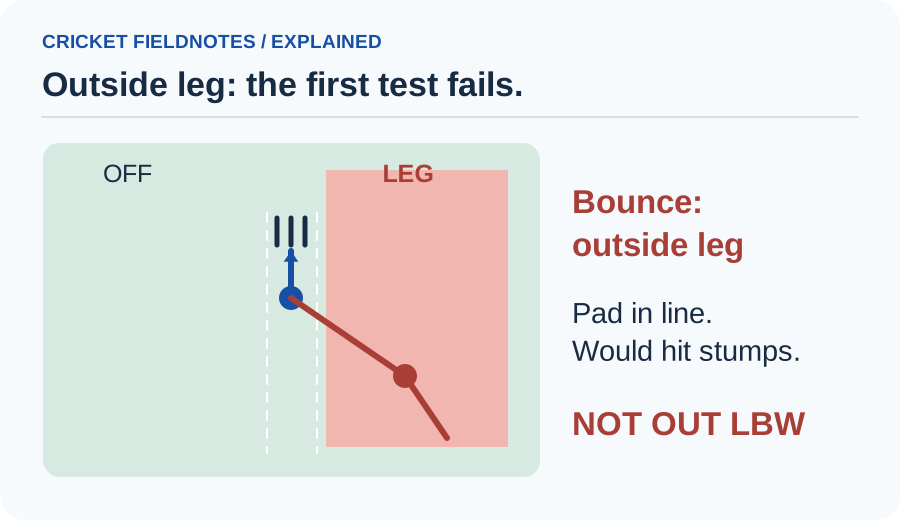
Hypothetical worked example. A right-handed striker misses a fair delivery that pitches clearly outside leg stump, turns, strikes the front pad in line, and is assessed as going on to hit middle stump. There was no prior bat contact. Despite the apparent threat to middle stump, the pitching condition fails, so the striker is not out LBW.
When explaining this to another viewer, begin at the bounce box. Starting with “it was hitting middle” encourages the discussion to revolve around the final box and forget an earlier requirement. You do not need to argue that the delivery was harmless. It can threaten the wicket and still fail an independent condition of this particular dismissal.
For practice, change the player's handedness in a sketch and redraw off and leg before adding the ball's route. Labels tied to the camera's left and right will fail as soon as the striker changes.
Worked example: the stroke attempt changes one test
Hypothetical worked example. A fair delivery pitches outside off, strikes the pad clearly outside off, and would go on to hit the wicket. The striker makes a genuine attempt to play it, with no bat contact. The outside-off impact means not out LBW.
Keep the delivery's path identical but have the striker offer no genuine stroke. That changes the impact requirement: outside-off impact can now qualify, subject to all the remaining conditions. It does not create an automatic dismissal. The projected path still has to meet the wicket, and an earlier disqualifying contact or pitching location still matters.
Write this as a controlled comparison. The point is to change one variable, not to compare two unrelated clips with different bowlers, camera angles and lengths. Controlled examples make the boundary easier to remember because the reason for the changed answer remains visible.
Worked example: reading Umpire's Call
Hypothetical worked example using the ICC Men's T20 World Cup 2026 review framework. Assume a fair delivery, no earlier bat contact, qualifying pitching and impact, and no other review exception. Tracking returns Umpire's Call for the wicket. With an original not-out decision, that marginal wicket finding does not overturn it to out. With an original out decision and the same finding, the wicket test does not overturn it to not out.
These are two explicitly different starting decisions. The graphic is part of a review procedure, so its meaning includes what is being reviewed. Record the on-field decision before the animation begins. Otherwise an apparently identical coloured marker can seem to produce inconsistent results when you have omitted an input.
Do not translate Umpire's Call into an invented percentage chance of dismissal. The ICC protocol defines categories and review thresholds. A colour is not a published probability estimate for that individual ball.
Slow down at first contact
LBW uses the first interception. Simultaneous bat-and-person contact is treated as bat first under MCC Law 36. A full toss can also be considered for LBW; the absence of a bounce does not settle the appeal. For a specific replay, avoid announcing an edge or a simultaneous contact when the available pictures and sound do not establish it.
Viewing exercise: pause at an appeal and complete your three boxes in pencil. Add the original decision. As the replay develops, change only the entry supported by new evidence. At the end, explain which condition decided the outcome, rather than repeating the complete list.
Edition and event scope: checked 5 September 2026. The review example cites one named 2026 event document and is not a promise that every match uses DRS or the same protocol. Check the applicable competition conditions and addenda for the match on screen.
Sources & scope
Worked examples and diagrams are illustrative, not live match records. Scene photographs are AI-generated illustrations. Rules are reviewed against the linked sources; the applicable competition’s playing conditions take priority.