 Get RS9 APK
The full fieldnote.
Open a chapter for the working, examples and exceptions.
Read the noun after maiden
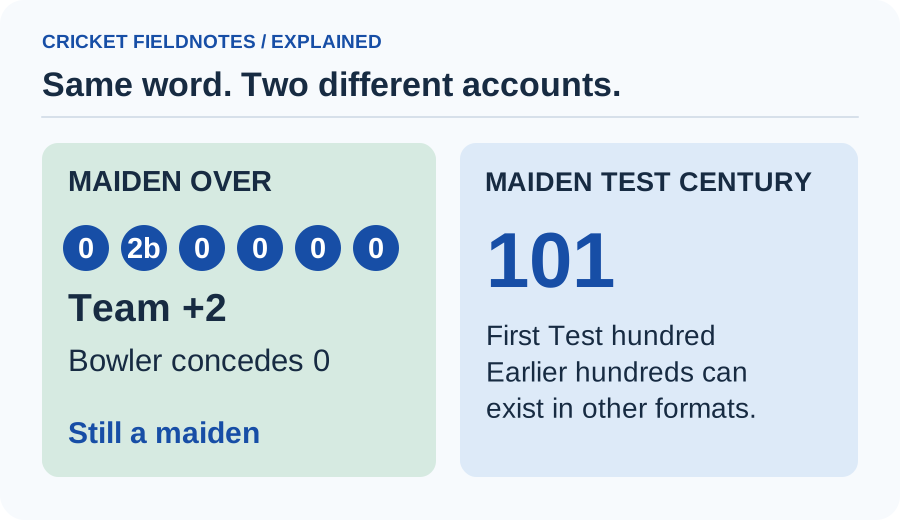
A maiden over belongs to the bowling account. A maiden century belongs to a batter's milestone record. The first phrase concerns runs conceded during an over; the second means a first hundred within a particular scope. A headline about a maiden Test century does not necessarily describe the player's first hundred in all cricket.
This distinction is useful whenever a commentator compresses a scorecard into a sentence. Ask what is being counted, whose record is involved and which competition or format the statement covers. The word maiden cannot answer those questions by itself.
Check the bowler's runs, not only the team score
For a completed over bowled by one bowler, the standard scoring test is whether any runs were charged to that bowler. The Queensland Cricket Scorers Association's guide explicitly allows byes and leg-byes within a maiden. Wides and no-ball penalties prevent one because they count against the bowler.
Our invented bowler Noor delivers each of the following separate overs. A dot means a valid ball with no run; there are no unusual penalty runs or scoring corrections.
| Delivery record | Team adds | Bowler concedes | Maiden? |
|---|---|---|---|
| Dot, dot, dot, dot, dot, dot | 0 | 0 | Yes |
| Dot, 2 byes, dot, dot, dot, dot | 2 | 0 | Yes |
| 1 wide, then six dots | 1 | 1 | No |
The third row contains seven deliveries but six valid balls. MCC Law 17 distinguishes the over's valid-ball count from every delivery attempted. Never decide that an over is complete just because six events appear in a commentary strip.
Attach a scope to the first hundred
Now imagine batter Arun already has two domestic first-class hundreds and one ODI hundred. He reaches 101 in a Test for the first time. Maiden Test century is an accurate description. First century ever would be inaccurate, because the earlier hundreds still exist.
A separate competition can also supply the scope. If Arun later makes his first hundred in a particular league, a headline may describe his maiden hundred in that league. Look for the omitted qualifier in the article or official statistics before repeating the claim.
ICC's report on Heinrich Klaasen's first ODI hundred illustrates this usage: the milestone is attached to ODIs. The phrasing identifies an achievement within a record set; it does not erase performances recorded elsewhere.
Follow the columns before interpreting the achievement
In a bowling table labelled O–M–R–W, M records maidens. An invented line of 4–1–18–2 therefore says four overs, one maiden, eighteen runs charged and two wickets credited. The one does not mean the bowler took their first career wicket.
For a batting milestone, inspect the batter's runs column. A team total of 100 is not a century for the striker, and a partnership of 100 is another shared account. A batter moving from 98 to 102 with a boundary reaches a hundred even though the displayed score never pauses at exactly 100.
Two shortcuts to avoid
Do not treat a maiden over as proof that nothing happened: wickets, byes or leg-byes may have occurred. Nor does a batter's first century establish how quickly it was made. Balls faced, match position and format supply that context.
These labels help organise a record. They are starting points for reading the innings rather than complete assessments of quality. A careful description keeps the measured achievement and the interpretation in separate sentences.
Reconcile the headline and the ledger
Practice: Noor bowls five dots and one ball yielding four leg-byes. Arun, who already has three ODI hundreds, makes his first T20I hundred. Can both performances contain a maiden?
Show the answer
Yes. Noor's completed over has no runs charged to her, so it is a maiden despite four team runs. Arun has a maiden T20I century, not a first century across every format.
Sources & scope
Worked examples and diagrams are illustrative, not live match records. Scene photographs are AI-generated illustrations. Rules are reviewed against the linked sources; the applicable competition’s playing conditions take priority.