 Get RS9 APK
The full fieldnote.
Open a chapter for the working, examples and exceptions.
The timer belongs to the request
DRS means Decision Review System. ICC distinguishes an Umpire Review, initiated by the officials, from a Player Review challenging an on-field decision. Seeing the third umpire on television does not by itself tell you which route was used.
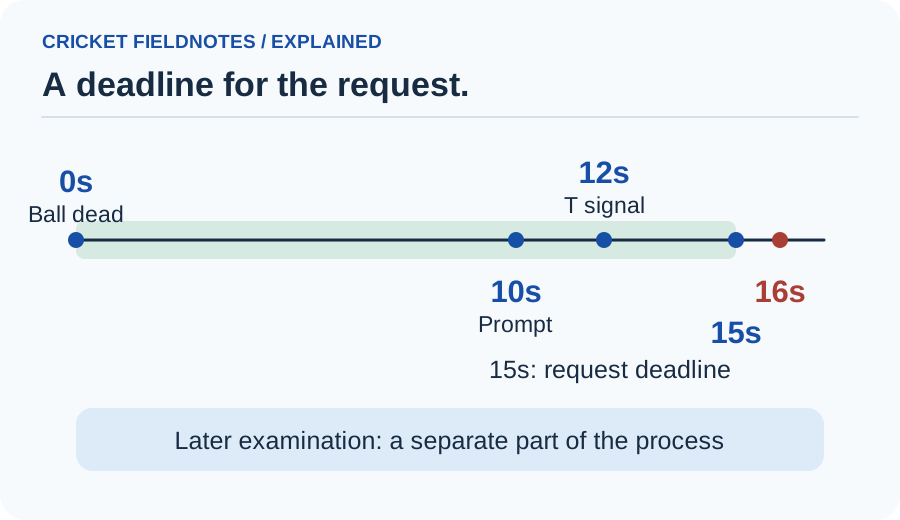
This guide uses the ICC men's T20I playing conditions effective July 2025, still listed by ICC when checked on 5 September 2026. Appendix D, paragraph 3.2.2 gives a fifteen-second request window measured from the ball becoming dead. Other competitions have their own conditions; this is not a universal promise about every league or club match.
Identify the player and the question
Under that protocol, the dismissed batter requests a review of an Out decision. The fielding captain requests a review of Not out. The request uses the recognised T gesture. The bowler's-end umpire prompts after ten seconds when no request has been made, and can decline a late request.
For the viewer, three short notes prevent confusion: original decision, requesting side, issue under review. For example, write Not out; fielding captain; possible LBW. Keep that note while the broadcaster moves through several replays. A close-looking image is evidence to interpret within the relevant decision process, not a new request.
Read an invented sequence as a timeline
Suppose an imaginary match uses the protocol above. The ball becomes dead at the zero point below. These teaching times are not a reconstruction of a broadcast incident, and all other eligibility requirements are assumed satisfied.
| Elapsed time | What happens | What the viewer can conclude |
|---|---|---|
| 7 seconds | Captain consults a nearby fielder | Discussion is not yet the review request |
| 12 seconds | Captain makes the T signal | The request is within the stated window |
| 16 seconds | A different captain first requests a review | This separate example is outside the window |
| 45 seconds | Third umpire examines the timely request | The fifteen-second deadline did not limit this examination |
Always identify the start event before doing arithmetic. Counting from the beginning of a television replay, a crowd reaction or an edited social clip produces an unsupported answer.
Do not start your stopwatch from a guess
MCC Law 20 explains when a ball becomes dead and when an umpire calls it. That is a cricket event, not simply the instant a fielder seems to relax. A clipped video may begin after the relevant event, or omit the signal that resolves an apparent timing dispute.
If you cannot see the full sequence, describe the evidence you have: the clip shows a gesture after a graphic changes. That is narrower and more defensible than declaring the request late from the graphic alone. Match officials administer the deadline.
Keep the over clock in a separate box
The stop clock addresses readiness for the next over. ICC's explanation of its 2025 changes describes a sixty-second interval between overs. It does not replace the Player Review window, and a review request does not gain a minute merely because an over has ended.
Before applying this guide to the IPL, a women's competition or a local league, open that event's playing conditions. Reviewable decisions, review allowances and technology arrangements can differ. The fact that a broadcast uses the letters DRS does not prove every competition uses identical procedures.
Test the boundary, not the drama
Practice: in our stated protocol, a valid request is made thirteen seconds after the ball becomes dead. The third umpire reaches a conclusion fifty seconds later. Has the request exceeded fifteen seconds?
Show the answer
No. Thirteen seconds is the request timing. Fifty seconds describes the subsequent examination. They measure different parts of the process. This answer assumes an eligible request and does not determine the eventual dismissal decision.
Sources & scope
Worked examples and diagrams are illustrative, not live match records. Scene photographs are AI-generated illustrations. Rules are reviewed against the linked sources; the applicable competition’s playing conditions take priority.